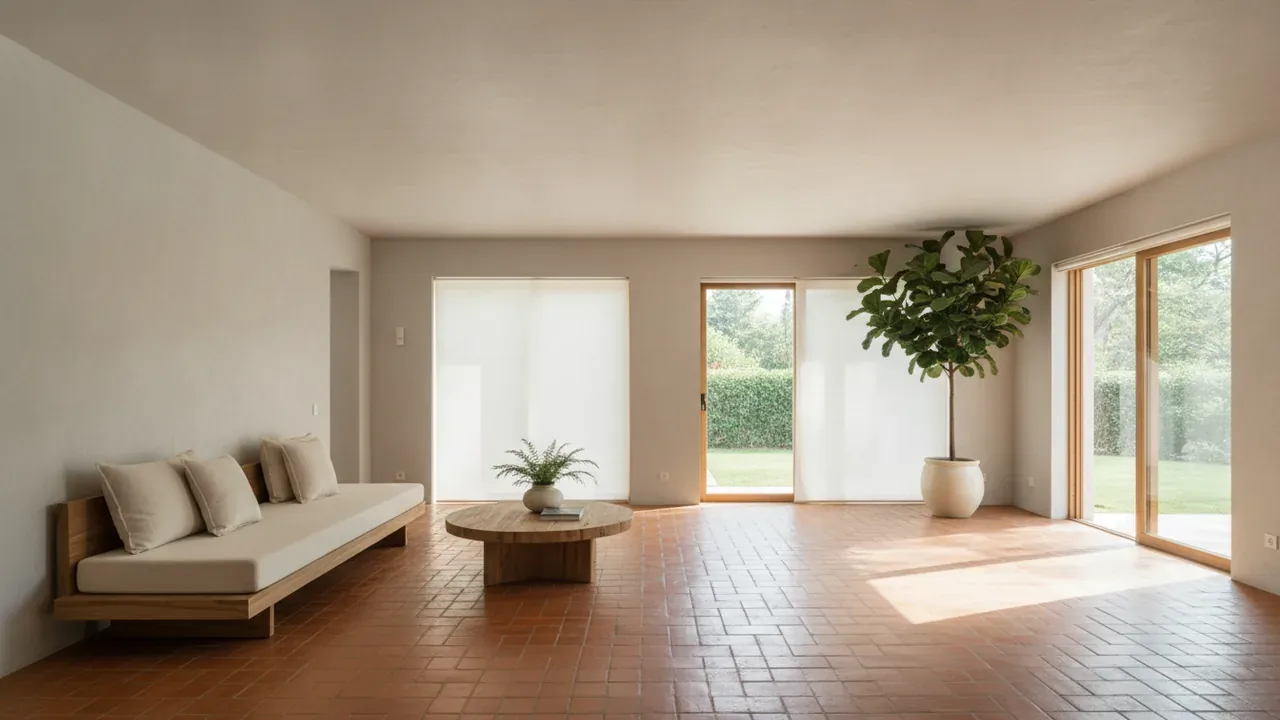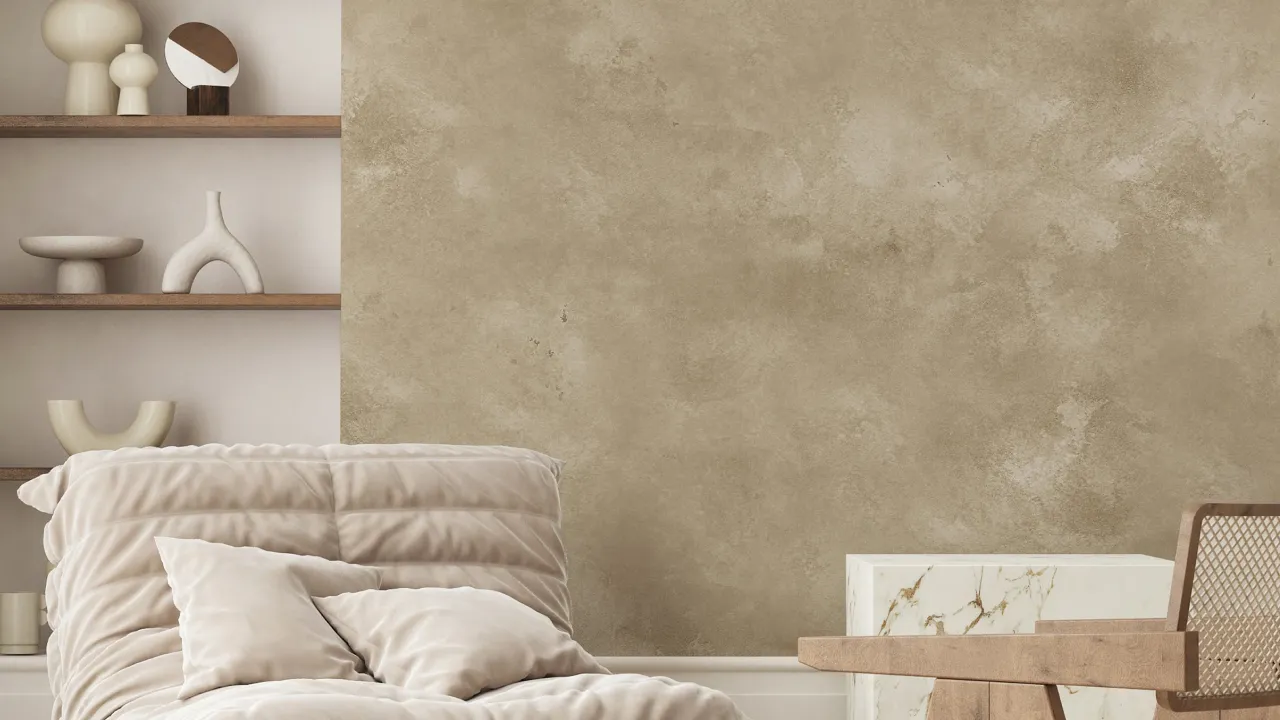
Lime wash is a natural wall finish made from slaked lime and water that soaks into porous walls and hardens into a soft, chalky, matte surface. It breathes, resists mould, and ages into a mottled patina instead of peeling, which is why a breathable lime finish suits humid Bengaluru walls better than a sealed plastic-emulsion coat.
What is lime wash?
Lime wash is a natural, breathable wall finish made from slaked lime (calcium hydroxide) suspended in water and tinted with natural pigments. It soaks into porous surfaces and hardens through carbonation into calcium carbonate, leaving a soft, chalky, matte surface that resists mould, releases moisture, and ages into a mottled patina instead of peeling.
Unlike a plastic emulsion, which sits on the wall as a sealed film, lime wash becomes part of the wall. It is a mineral finish, not a paint in the modern sense, and that single difference explains most of what follows: how it cures, why it breathes, and why it ages gracefully rather than flaking. It is closely related to whitewash, the older and plainer lime coating, and it is often used over lime plaster, which is a different product entirely.
What are the ingredients in limewash?
Limewash is made from slaked lime (calcium hydroxide) mixed with water, and tinted with natural mineral pigments or earth oxides. Traditional recipes sometimes add a little salt or casein to improve durability and adhesion. It contains no plastic binders and no synthetic solvents, which is why limewash is breathable and free of volatile organic compounds.
The chemistry is straightforward. Slaked lime is calcium hydroxide, made by adding water to quicklime. As Wikipedia and conservation sources describe, the finish is essentially a lime paint, and its colour comes from lime-stable mineral pigments rather than the wide synthetic palette of emulsion paints. That is the source of both its strength, a genuinely natural and low-toxicity material, and one of its limits, a softer and more muted colour range.
How does lime wash work on a wall?
Lime wash works by carbonation. The slaked lime soaks into a porous, damp wall, and as it dries it reacts with carbon dioxide in the air and turns back into calcium carbonate, effectively a soft limestone bonded to the surface. Because the cured film is porous, the wall can still breathe, releasing moisture instead of trapping it behind a sealed coat.
This is why lime wash behaves so differently from emulsion. A breathable finish lets a wall give up moisture to the air, which matters on solid masonry and in humid conditions, where a sealed plastic film can trap damp and lift. The trade-off is that carbonation takes time and needs the right conditions, so a fresh lime wash stays fragile for a while and is sensitive to rain until it has cured.
What is a lime wash used for?
Lime wash is used as a breathable finish on porous walls: brick, stone, masonry, and lime or cement plaster, both inside and out. It is chosen for its soft chalky look, its resistance to mould and mildew, and its low toxicity. On non-porous surfaces, such as previously emulsion-painted walls, it needs a bonding primer or it will not key in.
Indoors, lime wash gives a calm, matte, light-diffusing surface that pairs naturally with natural materials and planting, which is part of why it appeals to homeowners who want a home that feels connected to nature. Outdoors, it suits sheltered masonry and traditional facades. A breathable lime finish earns its place when it suits the wall and the local climate it lives in, which is the kind of judgment that goes into how we design a nature-connected home in Bengaluru, choosing each finish for the surface and the climate rather than by habit.
Lime wash vs whitewash vs lime plaster
Lime wash, whitewash, and lime plaster are related but different. Lime wash and whitewash are both thin, breathable lime coatings; whitewash is the older, plainer term, while lime wash usually means the refined, pigmented, patina-forming version. Lime plaster is not a wash at all but a built-up lime surface coat, and lime wash is often applied over it.
| Finish | What it is | Made from | Best on |
|---|---|---|---|
| Lime wash | A thin, breathable wash that soaks into the wall and ages to a chalky, mottled patina | Slaked lime, water, natural pigment | Porous masonry, brick, lime plaster |
| Whitewash | The older, plainer lime coating, often with chalk or salt added, flatter and less pigmented | Slaked lime or chalk, water, simple additives | Fences, outbuildings, utilitarian and historic surfaces |
| Lime plaster | A lime-based plaster, a built-up surface coat rather than a wash (not a paint) | Lime, sand, water | The wall surface itself, which lime wash can then be applied over |
Lime wash also sits alongside other natural wall systems worth comparing. For related earthen techniques, read the guides to the mud house and rammed earth walls, and for the full low-carbon range, start with the sustainable building materials pillar.
What are the disadvantages of lime wash?
The real disadvantages of lime wash are that it needs several thin coats, stays fragile while it cures, offers limited colour saturation, and takes skill to apply evenly. Basic limewash also resists driving rain poorly, which is the disadvantage most sellers and DIY guides leave out, and the one that matters most in a monsoon climate.
An honest list, drawn from conservation and natural-finish sources:
- Multiple coats: lime wash is applied thin, so three or more coats are normal to build an even finish, which takes time.
- Fragile while curing: until carbonation completes, the finish is soft and rain-sensitive, so timing and weather matter during application.
- Limited colour: only lime-stable mineral pigments work, so the palette is muted and chalky rather than deeply saturated.
- Skill to apply: an even, streak-free lime wash is a craft; a careless coat looks patchy, and lime is caustic, so it needs care to handle.
- Weak against driving rain: as Wikipedia notes, basic limewash struggles to keep out rain-driven water, which is why exposed exterior walls in a wet climate need proper preparation or shelter.
None of these makes lime wash a poor choice. They make it a finish that rewards the right surface, the right preparation, and an honest match to where it is used.
Does lime wash suit Bengaluru’s climate?
Lime wash suits Bengaluru’s climate on the right surfaces. Its breathability and mould resistance are a real advantage in Bengaluru’s humid, monsoon-prone air, where a sealed emulsion can trap damp and grow mildew. The condition is exposure: basic lime wash resists driving rain poorly, so it works best on interiors and sheltered walls, while monsoon-facing exterior surfaces need proper preparation or a different finish.
This is the honest, climate-grounded answer the sellers and DIY guides skip. For a Bengaluru home, breathability is the headline benefit. A lime-washed interior or a shaded masonry wall can release moisture and stay free of the black mildew that humidity brings to plastic-painted walls. That behaviour is a general property of breathable lime finishes, and it is exactly the kind of climate-responsive, natural-material thinking the studio designs around.
The caution is just as important. Bengaluru’s monsoon is heavy, and an unprepared lime wash on an exposed west or south wall faces driving rain it was never strong against. The right response is not to avoid lime, but to place it well: lime wash on interiors and protected facades, deeper eaves and good detailing where it does go outside, and a frank conversation about surface porosity and preparation before any wall is committed. Whether lime wash suits a specific wall in your home depends on that surface, its exposure, and its preparation, which is a judgment best made on site.
How to apply lime wash
Lime wash is applied in several thin coats onto a clean, damp, porous wall, brushed on and then mist-cured so the lime carbonates slowly. Non-porous or previously emulsion-painted surfaces need a bonding primer first. Because lime is caustic and an even finish takes practice, larger or exterior jobs are best handled by a skilled applicator.
At a high level, the steps are clean: prepare and dampen the surface, prime if it is non-porous, brush on thin coats letting each dry, and keep early coats lightly misted so they cure rather than dry too fast. The detail that decides the result, how many coats, how much water, how long between them, depends on the surface, the weather, and the look you want, so treat any single recipe as a starting point rather than a rule.
What is the cost of limewash paint in India?
Limewash material in India typically falls in roughly the Rs 250 to 400 per litre range, according to market listings such as NoBroker, though it varies by brand and pigment. That figure is the material price only. The applied cost depends on the number of coats, surface preparation, and the area covered, so a per-litre price is not the same as a finished-wall cost.
Two honest points on cost. First, the material itself is rarely the deciding factor; preparation, the number of coats, and skilled application are where the real cost sits, especially on tricky or exterior surfaces. Second, AD Studio 9 does not sell paint and does not quote finishes by the square foot. For project work, the studio quotes on consultation, because a finish is only one decision inside a whole design. A free 45-minute consultation at the RR Nagar studio in Bengaluru is where those choices are weighed together.
Frequently asked questions
What is a lime wash used for?
Lime wash is used as a breathable, natural finish on porous walls: brick, stone, masonry, and lime or cement plaster, inside and out. It is chosen for its soft chalky look, its resistance to mould, and its low toxicity. On non-porous surfaces it needs a bonding primer first.
What are the ingredients in limewash?
Limewash is made from slaked lime (calcium hydroxide) mixed with water, and tinted with natural mineral pigments or earth oxides. Traditional recipes sometimes add a little salt or casein to improve durability. It contains no plastic binders and no synthetic solvents, which is why it is breathable and VOC-free.
How do I make my own lime wash?
Lime wash is made by thinning slaked lime putty or hydrated lime with water to a milk-like consistency, then stirring in natural pigment. Lime is caustic, so gloves and eye protection are needed. The wall is dampened, then several thin coats are brushed on and mist-cured. For exterior or large jobs, a skilled applicator gives a more reliable result.
What are the disadvantages of lime wash?
The disadvantages of lime wash are that it needs several thin coats, stays fragile while curing, offers limited colour saturation, and takes skill to apply evenly. Basic limewash also resists driving rain poorly, so monsoon-exposed exterior walls need proper preparation or a sheltered position.
What is the cost of limewash paint in India?
Market listings such as NoBroker put limewash material in roughly the Rs 250 to 400 per litre range, varying by brand and pigment. That is the material price only; the applied cost depends on coats, surface preparation, and area. AD Studio 9 quotes project work on consultation, never per square foot.
Choosing lime wash for a Bengaluru home
Lime wash is one of the most honest finishes you can put on a wall: natural, breathable, low-toxicity, and quietly beautiful as it ages. It rewards the right surface and the right placement, and in a humid, monsoon city like Bengaluru, placement is everything. If you are weighing lime wash or other natural finishes for your walls, the next step is a conversation about your surfaces and your climate. Book a free 45-minute consultation at the RR Nagar studio, or read more about designing a biophilic home.