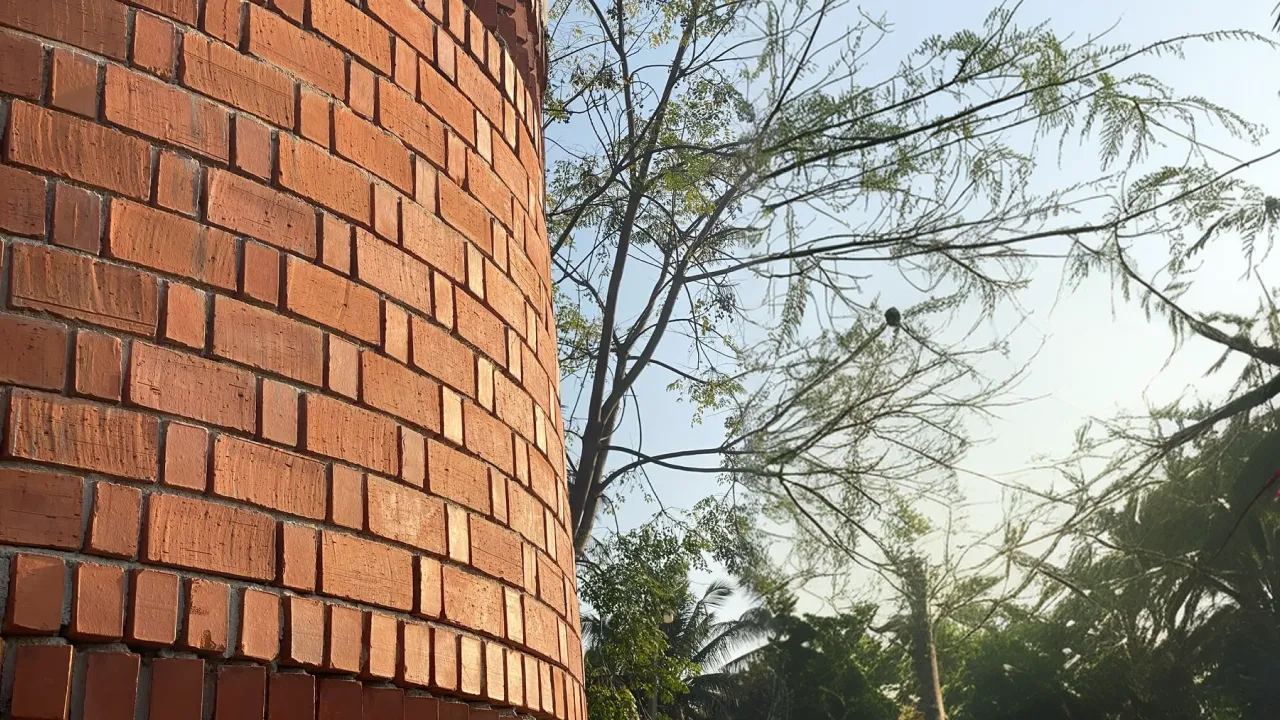
Rat trap bond is a brick masonry technique where bricks are laid on edge to leave a hollow cavity inside the wall, cutting brick and mortar use by about 30% and trapping air that keeps interiors cooler. Popularised in India by architect Laurie Baker, it suits Bengaluru’s warm climate when the site and the masonry are right.
What is rat trap bond?
Rat trap bond is a brick masonry technique in which bricks are laid on edge rather than flat, leaving a hollow cavity inside a wall of standard 230 mm thickness. The cavity uses roughly 30% less brick and mortar and traps a layer of air that slows heat transfer, which is why it is used in cost-conscious, climate-responsive construction. It is also called the Chinese brick bond.
The name describes the wall’s section: the gaps between bricks form a regular pattern of voids, like a row of small traps. By turning each brick on its edge, the 110 mm face shows instead of the usual 75 mm, and the inner cavity is created without any extra material. Here is how it compares to a conventional solid brick wall:
| Feature | Rat trap bond | Conventional solid brick wall |
|---|---|---|
| Brick orientation | Laid on edge, 110 mm face shown | Laid flat, 75 mm face shown |
| Wall section | 230 mm wall with a hollow internal cavity | 230 mm wall, solid throughout |
| Brick and mortar use | About 30% less, fewer bricks per wall | Full material use |
| Thermal behaviour | Air cavity slows heat transfer, cooler interiors | Solid mass, no insulating cavity |
| Sound | Poorer sound insulation through the cavity | Better sound blocking from solid mass |
| Finish | Often left exposed as a feature wall | Usually plastered and painted |
How is a rat trap bond wall built?
A rat trap bond wall is built by laying bricks on edge in a repeating pattern of pairs and gaps, so each course alternates to form a continuous internal cavity in a 230 mm wall. The base course, the top course, and the courses at sill and lintel level are usually laid solid for strength, and reinforcement can be run through the cavities where the design needs it.
The discipline is in the setting out and the mortar control. Because the wall is hollow, the mason has to keep the cavity clean and the coursing exact, and the solid bands at the base, top, sill, and lintel tie the wall together and carry concentrated loads. Where extra strength is needed, steel can be placed in the cavities and filled, in the way reinforcement is used in any cavity wall. This is precise work, and the quality of the result tracks the skill of the team that lays it.
What are the advantages of rat trap bond?
The advantages of rat trap bond are lower material use, cooler interiors, a lighter wall, and an attractive finish. The cavity removes roughly 30% of the brick and mortar a solid wall would need, the trapped air slows summer heat, the wall weighs less and so reduces dead load, and the brickwork can be left exposed as a feature instead of being plastered and painted.
These benefits are well attributed. Researchers and practitioners report brick savings of around 25 to 30%, with A.R. Santhakumar and Canada Masonry research often cited for the figure, and the technique was central to Laurie Baker’s low-cost, climate-responsive buildings in Kerala, where it cut cost and lowered indoor temperature. Used well, rat trap bond is the kind of honest, resource-light wall that eco-friendly architects in Bengaluru reach for when a brief calls for lower cost and a cooler home, provided the site and the masons suit it.
What are the disadvantages of rat trap bond?
The real disadvantages of rat trap bond are poorer sound insulation, a heavy dependence on skilled masonry, extra cleaning if the brick is left exposed, and a practical limit of about two storeys without added structural design. The cavity that helps with heat is the same cavity that lets sound through more easily, which is the honest trade-off most pages skip.
An honest list of the limits:
- Poor sound insulation: the air cavity that slows heat also carries sound, so a rat trap bond wall blocks noise less well than a solid wall (ResearchGate, theconstructor.org).
- Mason-skill dependency: the exposed, hollow coursing leaves no room for error, so the result depends heavily on an experienced team. As the studio’s construction-first discipline, led on site by principal architect Gandharv Krishna, puts it, mason skill decides the outcome here more than on a plastered wall.
- Cleaning and upkeep: left unplastered for the exposed look, the brick needs careful pointing and occasional cleaning.
- Storey limit: it suits small residential buildings up to about two storeys, beyond which it needs extra structural design or an RCC frame.
None of these rules out rat trap bond. They define where it belongs: the right home, the right height, and the right masons.
Does rat trap bond insulate?
Rat trap bond insulates against heat, not against sound. The air cavity slows heat transfer, so interiors stay cooler, with practitioner and research reports citing peak-summer reductions of about three to four degrees. The same cavity carries sound more easily than a solid wall, so rat trap bond is a weaker acoustic barrier. It is a thermal advantage and an acoustic compromise in one wall.
It helps to separate the two questions cleanly. On heat, the trapped air is a genuine, if modest, thermal break, and it is one reason Laurie Baker’s brick buildings stay cooler in a hot climate. On sound, the cavity is a weakness, so for a bedroom wall against a noisy road or a shared boundary, a solid or specially detailed wall is the better acoustic choice. The temperature figures above come from research and practitioner measurements, not from an AD Studio 9 project.
Can rat trap bond be used in RCC or multi-storey buildings?
Rat trap bond is load-bearing and is considered safe for small residential buildings up to about two storeys, with correct design and reinforcement in the cavities. For taller or more complex buildings, it is used as infill within an RCC frame rather than as the load-bearing structure. In every case, a structural engineer should sign off the design.
Studies such as those indexed on scispace and IJARSE support its use as a load-bearing wall within that two-storey range, especially when the cavities carry reinforcement at the right points. Beyond that, the sensible route is to let an RCC frame take the structural load and use rat trap bond as a cooler, lighter infill wall. The decision is a structural one, so it belongs with an engineer who has seen your plan and your site, not with a rule of thumb.
What does rat trap bond cost?
Rat trap bond lowers material cost because it needs roughly 25 to 30% fewer bricks and less mortar than a solid wall, but skilled masonry can offset part of that saving. There is no fixed rate. The price of a thousand bricks is a local-market figure that varies by brick type and supplier, and the finished cost depends on the wall, the labour, and whether the brick is left exposed.
Two honest points on cost. First, the saving is in needing fewer bricks, not in a cheaper brick, so the benefit is real but it is tied to the design and the wall area, not to a headline per-square-foot number. Second, AD Studio 9 does not quote walls by the square foot, because a technique like this is one decision inside a whole design and a whole site. For project work, the studio quotes on consultation, and a free 45-minute consultation at the RR Nagar studio in Bengaluru is where those numbers are worked out honestly.
Is rat trap bond right for a Bengaluru home?
Rat trap bond suits many Bengaluru homes, with conditions. The city’s warm days make the cavity’s cooling genuinely useful, and the lower material use fits a cost-conscious, climate-responsive brief. The conditions are sound and skill: keep it away from walls that must block noise, and use it only with masons experienced in the bond. On the right wall, with the right team, it is a strong choice.
This is the verdict a named local architect can give that a global guide or an academic PDF cannot. For a Bengaluru home, rat trap bond earns its place on external and non-acoustic internal walls, where its cooling and savings count and its sound weakness does not matter. It is less suited to bedroom party walls or rooms that need quiet. A cavity wall like rat trap bond only earns its cooling and its savings when it is matched to the right home, site, and mason, which is the judgment a climate-responsive practice brings before the first brick is laid.
If you are weighing rat trap bond against a conventional wall, it sits in the same family as other resource-light, climate-first choices. It pairs naturally with cooler roofing such as filler slab roofing, with the warmth of exposed brick as a finish, and with earthen walls such as rammed earth walls. For the full set of low-carbon options, start with the sustainable building materials pillar.
Frequently asked questions
What is the rat trap bond method?
Rat trap bond is a brick masonry method where bricks are laid on edge to leave a hollow cavity inside a 230 mm wall. The cavity cuts brick and mortar use by about 30% and traps air that slows heat transfer. It is also called the Chinese brick bond, and was popularised in India by architect Laurie Baker.
What are the advantages of rat trap bond?
The advantages of rat trap bond are lower material use, around 30% fewer bricks and less mortar, cooler interiors from the air cavity, a lighter wall that reduces dead load, and an attractive exposed-brick finish that needs no plaster. These savings are attributed to research and practitioners, not measured by AD Studio 9.
What are the disadvantages of rat trap bonds?
The disadvantages of rat trap bond are poorer sound insulation through the cavity, a strong dependence on skilled masonry, more cleaning if the brick is left exposed, and a practical limit of about two storeys without extra structural design. The technique rewards an experienced team and careful detailing.
Does rat trap bond insulate?
Rat trap bond insulates against heat, not against sound. The air cavity slows heat transfer, so interiors stay cooler, with reports citing peak-summer reductions of about three to four degrees. The same cavity carries sound more easily, so rat trap bond is a weaker acoustic barrier than a solid wall.
Can rat trap bond be used in RCC?
Rat trap bond is load-bearing and is considered safe for small residential buildings up to about two storeys with correct design and reinforcement in the cavities. For taller buildings it is used as infill within an RCC frame. Either way, a structural engineer should sign off the design.
Choosing rat trap bond for a Bengaluru home
Rat trap bond is one of the most honest cost-and-comfort techniques in Indian brickwork: less material, cooler rooms, and a wall that wears its making on its face. It rewards the right wall, the right height, and the right masons, and in Bengaluru’s warm climate that combination is often within reach. If you are weighing rat trap bond for your home, the next step is a conversation about your site and your priorities. Book a free 45-minute consultation at the RR Nagar studio, or talk to an architect who can tell you if it suits your site.