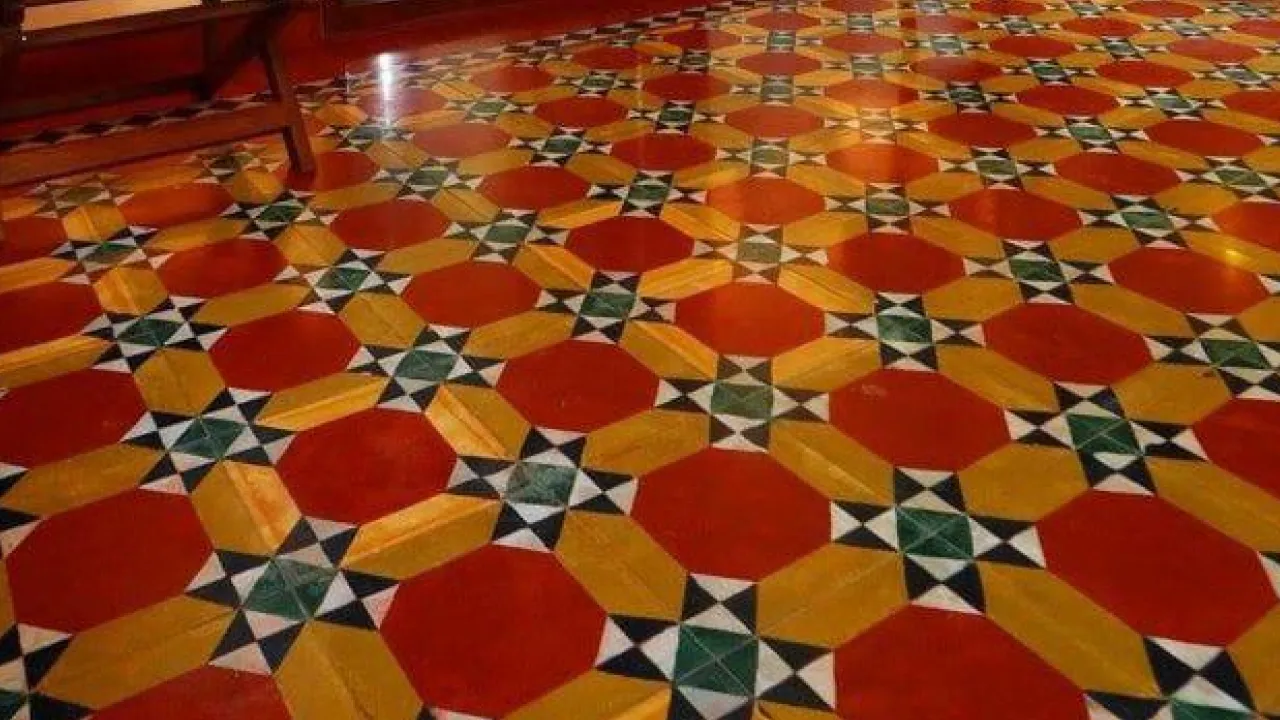
Athangudi tiles are handmade cement floor tiles from Athangudi village in the Chettinad region of Tamil Nadu. Each one is cast by hand: natural oxide pigments, river sand and cement are poured over a glass plate and sun-dried rather than kiln-fired. The result is a glossy, colour-rich floor that stays cool underfoot and softens into a patina with age.
That cool-underfoot quality is exactly why architects reach for athangudi in a warm climate. It is also where most online guides stop being useful. Sellers list colours and prices. Almost none tell you where the tile struggles, how it is actually laid, or whether it suits the way you live. This guide does, written from the way a Bengaluru practice specifies vernacular floors.
What are athangudi tiles, and what makes them special?
| Three things set athangudi tiles apart. Each is hand-cast, so no two are identical. The colour comes from natural oxide pigments laid by hand, and the gloss comes from casting against a glass plate, not a surface glaze. The dense cement body stays cool underfoot, which is why the tile reads as a climate-smart floor rather than a decorative one. |
Athangudi tile-making is a Chettinad craft documented across roughly five centuries, named after the village where it took hold. What you buy is not a printed pattern. A craftsman draws each design in oxide pigment, so the colour sits in the body of the tile and wears slowly rather than rubbing off a glaze.
At AD Studio 9, athangudi sits in the same family as kota stone, IPS, terracotta and lime plaster: the sustainable materials we build with. We choose a floor for how it behaves in the heat, not only how it looks, which is the instinct behind our biophilic home design work across Bengaluru.
The three traits that matter
- Hand-cast individuality. Every tile is poured by hand, so colour and veining vary slightly. That variation is the character, not a defect.
- Oxide colour, glass-formed gloss. Natural oxide pigments give deep, stable colour, and the glass plate the tile is cast on leaves a smooth, low-sheen shine without any glaze.
- Cool, dense body. The cement body holds temperature down, so the floor feels cool on bare feet through a warm afternoon.
How are athangudi tiles made?
| Here is the real process, because the web often gets it wrong. A craftsman sets a clean glass plate, lays a patterned stencil, and pours natural oxide pigment to draw the design. River sand and cement go on top as the body, the tile is pressed and demoulded, then cured in water and sun-dried in open air. Athangudi tiles are not kiln-fired. The glass plate, not a glaze, gives the surface its shine. |
The sequence is simple to describe and hard to do well, which is why skilled makers matter.
- A clean glass plate is prepared as the casting surface. The smoothness of the glass becomes the smoothness of the finished tile.
- A stencil sets the pattern, and natural oxide pigments are poured by hand to draw the colour and design.
- A layer of fine river sand and cement is added as the structural body of the tile.
- The tile is pressed, then carefully lifted off the glass.
- It is cured in water, then sun-dried in open air over several days. No kiln, no high-temperature firing.
Two facts follow from that process. Because the tiles air-cure rather than fire, shades differ slightly between batches, so a floor is best ordered in one lot. And because the gloss is the imprint of the glass plate, it is part of the tile, not a coating that scratches off. Tiles are commonly made in 200 x 200 mm and 300 x 300 mm squares, with larger and custom sizes to order.
Are athangudi tiles waterproof, and where do they work in a home?
| Athangudi tiles are water-resistant once sealed, not waterproof. The cement body is porous, so an unsealed tile absorbs water and stains. Sealed and maintained, the tile handles living rooms, bedrooms, verandahs and pooja rooms well. In open kitchens and bathrooms it needs a good sealant, careful detailing at wet edges, and an owner who will re-coat it. Plan the wet areas, and it performs. |
Most worries about athangudi come down to one honest fact: the tile is porous. Water and oil sit on a sealed surface and wipe away. On an unsealed tile they soak in and mark. So the question is not whether athangudi resists water, it is whether you will seal and maintain it.
Where it suits, and where to take care
- Strong fit: living rooms, bedrooms, study, verandahs, pooja rooms, and other low-to-medium-traffic indoor floors.
- Use with care: open kitchens and bathrooms. Specify a quality sealer, detail the wet edges and gradients properly, and commit to periodic re-coating.
- The maintenance answer to “do they stain”: sealed tiles shrug off everyday spills. The discipline is re-sealing on schedule, not daily fuss.
What are the disadvantages of athangudi tiles?
| The honest disadvantages, framed as what to plan for: the tile is porous and stains if you skip sealing; it needs periodic re-polishing to hold its gloss; it chips when mishandled or badly laid; it is made to order, so lead times run into weeks and shades vary slightly between batches; and it needs skilled cement-tile masons plus proper curing time. None is a dealbreaker. Each is a planning item. |
This is the part sellers skip. Athangudi is a fine floor, and it asks something of you in return. Knowing the trade-offs before you commit is what separates a floor you love from one you regret.
- Porous body. Skip sealing and it stains. Plan a quality sealer at handover and a re-seal schedule.
- Periodic re-polishing. The gloss dulls with years of footfall and returns with a light re-polish. Budget for it, the way you would for a wooden floor.
- Chips if mishandled. Sharp impacts and careless laying chip the edges. Skilled handling on site prevents most of it, and a single tile can be lifted and replaced.
- Made-to-order lead time. These are hand-cast in batches, so allow weeks, not days, and order the full floor in one lot to keep shades consistent.
- Batch shade variance. Small colour shifts between batches are normal for a handmade tile. Order together, and dry-lay before fixing.
- Needs skilled installers and curing time. Cement-tile laying is a craft. The right masons and unhurried curing are the difference between a floor that lasts decades and one that fails early.
We treat each of these as a specification, not a surprise. We name the sealer, batch the order in a single lot, brief the masons on handling and curing, and dry-lay for shade before anything is fixed. Handled that way, the disadvantages become a checklist, not a risk.
Are athangudi tiles costly, and how do they compare to vitrified tiles?
| Athangudi tiles cost more than a basic vitrified tile, and the honest answer to “how much” is not a per-square-foot number. The tile itself is moderately priced. Cost is driven by five things: design complexity, the floor area, sealing and finishing, the skill of the masons laying it, and the made-to-order lead time. The laying and the upkeep, not the tile, decide the final figure. |
People reach for a single rate per square foot because it feels comparable. For a hand-laid floor it misleads. A plain single-colour athangudi floor and an intricate patterned one use the same tile and land at very different costs, because the labour and the design are where the money goes.
Athangudi against vitrified and ceramic
| Trait | Athangudi | Vitrified | Ceramic |
| How it is made | Hand-cast on a glass plate, sun-dried | Pressed and fired at high heat with silica | Clay pressed and glaze-fired |
| Underfoot feel | Dense, stays cool | Hard, warms in sun | Hard, varies |
| Water resistance | Resistant when sealed, porous if not | Very low water absorption | Low, glaze dependent |
| Maintenance | Seal and re-polish periodically | Wipe clean, minimal | Wipe clean, minimal |
| Repair | Single tiles re-laid by a mason | Hard to match, full replacement | Replaceable, match varies |
| Character over time | Softens into a patina | Uniform, unchanging | Uniform, unchanging |
| Lead time | Made to order, runs into weeks | Off the shelf | Off the shelf |
Read the table as a trade-off, not a scoreboard. Vitrified and ceramic win on price, water tolerance and zero maintenance. Athangudi wins on a cool-underfoot floor with depth, character and a patina that improves with age. If you want the latter, the honest planning question is cost over the life of the floor, including upkeep.
What actually drives the cost
- Design complexity: plain field, border, or full pattern.
- Floor area and the number of cuts at edges and corners.
- Sealing and finishing: the sealer chosen and the re-polish plan.
- Skilled laying: experienced cement-tile masons cost more and save you from early failure.
- Lead time and logistics for a made-to-order, single-lot order.
We do not quote a per-square-foot rate, because it would not be honest for a floor this hand-dependent. We scope the floor, then give you a clear number. The first consultation at our RR Nagar studio is free, and you can also compare athangudi against sibling finishes like oxide flooring and IPS flooring before you decide.
Using athangudi tiles in a Bengaluru home
| In a Bengaluru home, the value of athangudi is a floor that stays cool without help. Bengaluru rewards passive design: cross ventilation, shaded openings, and dense, cool-underfoot surfaces that take the edge off warm afternoons. A vernacular cement floor like athangudi fits that logic, the same logic behind our climate-responsive, biophilic work. The floor is one move in a house designed to stay comfortable on its own. |
A material earns its place when it does real work. In Bengaluru’s climate, a dense cement floor is a quiet piece of passive cooling: it holds temperature down underfoot and pairs naturally with courtyards, deep shade and cross ventilation. That is how we think about every surface in a home, as part of how the building keeps itself comfortable.
Our own studio, Akshara Vinyasa in RR Nagar, is the built proof of that thinking. It runs without air-conditioning, cooled by orientation, cross ventilation and a living terracotta-tile facade, work that earned a FOAID 2025 Silver award. Akshara Vinyasa uses terracotta rather than athangudi, so we will not pretend otherwise. What it demonstrates is the discipline we bring to any vernacular, cool-bodied material, athangudi included.
As Ar. Apoorva Lekha puts it, “Our work explores tropical modernism through environmental intelligence, material authenticity, and spatial clarity.” Athangudi is one honest, regional material that sits squarely inside that approach.
If you are weighing athangudi for your own floor, the questions that matter are where it works, where it does not, and how it is laid, the same call we make when we specify vernacular materials in a climate-responsive Bengaluru home. When you are ready, designing a nature-connected Bengaluru home starts with a free conversation at our RR Nagar studio, where you can see how a floor like athangudi fits the larger plan.
Frequently asked questions
What is special about Athangudi tiles?
Three things. Each tile is hand-cast, so no two match. The colour comes from natural oxide pigments laid by hand, and the gloss comes from casting against a glass plate rather than a surface glaze. The dense cement body stays cool underfoot, which makes it a climate-smart floor.
Are Athangudi tiles waterproof?
Water-resistant once sealed, not waterproof. The cement body is porous, so an unsealed tile absorbs water and stains. Sealed and maintained, it handles living rooms, bedrooms and verandahs well. In open kitchens and bathrooms it needs a good sealant and careful detailing at wet edges.
What are the disadvantages of Athangudi tiles?
Plan for five things: the porous body stains if you skip sealing, it needs periodic re-polishing, it chips when mishandled or poorly laid, it is made to order so lead times run into weeks with slight batch shade variance, and it needs skilled cement-tile masons plus proper curing time.
Are Athangudi tiles good or bad?
Good for low-to-medium-traffic indoor floors in a warm climate when sealed and laid by skilled masons. Less suited to neglected wet areas or rough handling. The verdict depends on the use-area, the sealing routine and installer skill, not on the tile alone.
Is Athangudi tiles costly than normal tiles?
It costs more than a basic vitrified tile. The tile itself is moderately priced. The real cost lives in skilled laying, sealing and upkeep, not in the tile. A single per-square-foot number out of context is not meaningful, so price it against your scope.
How much does 1 sq ft of tile cost?
There is no honest single per-square-foot figure for athangudi. The cost depends on design complexity, floor area, sealing and finishing, mason skill and the made-to-order lead time. Ask for a scoped estimate against your floor rather than a flat rate.