Kota stone is a fine-grained limestone from Rajasthan, valued for staying cool underfoot and holding up to years of hard use. In our own RR Nagar studio, Akshara Vinyasa, we laid it on the Architect’s-cabin balcony for exactly that reason: a grounded, naturally cool surface that sits well with Bengaluru’s climate. Here is how it works and where it fits.
What is kota stone? (and which rock is it?)
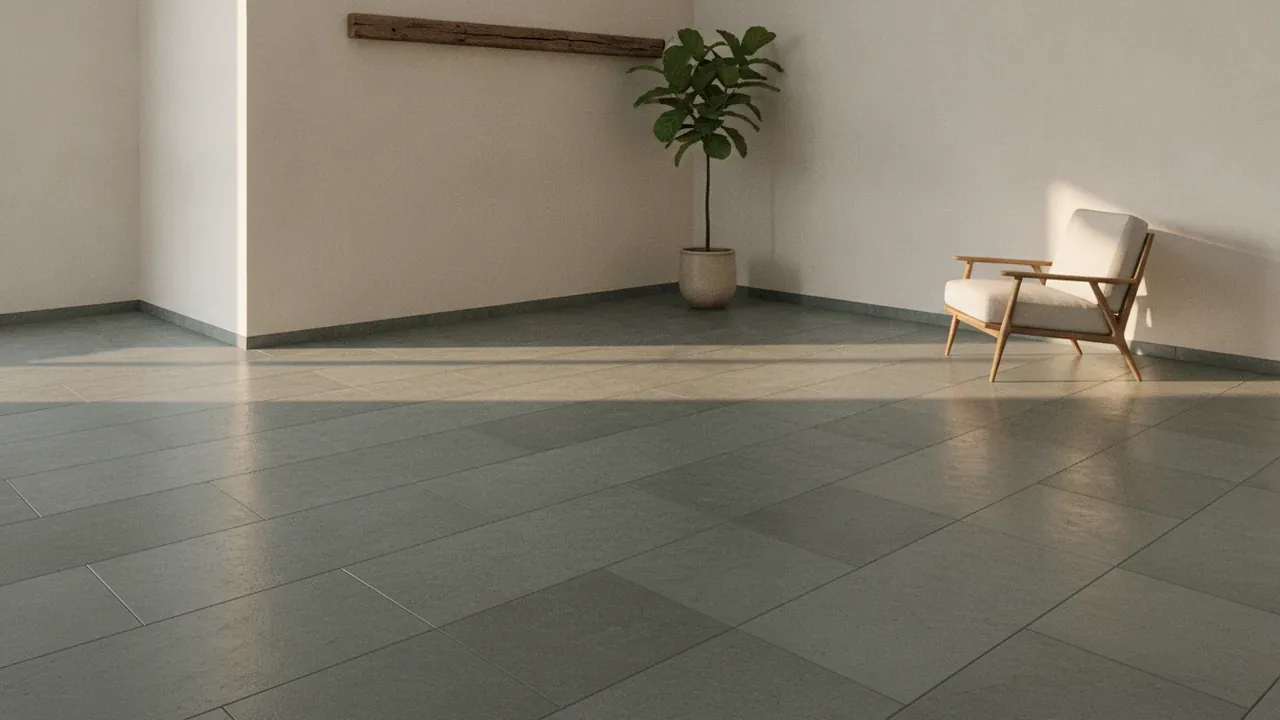
Kota stone is a fine-grained sedimentary limestone quarried in the Kota and Ramganj Mandi belt of Rajasthan. Geologically it is a limestone, not a granite or a marble. It reaches your home in earthy greenish-grey and beige tones, cut into small tiles, with a naturally cool, matte surface that suits floors and balconies.
The stone forms from compacted calcareous sediment, which is why its colour runs to muted greens, browns and greys rather than the flecked crystalline look of granite. According to industry material data, a typical composition sits around calcium carbonate 38 to 40 percent, silica 24 to 25 percent and magnesium oxide 4 to 5 percent. That mineral mix gives it a hard wearing surface at a lower price point than most polished granites.
Because it is limestone, it behaves like limestone: dense enough to take heavy foot traffic, porous enough to need sealing. That single fact shapes almost every decision about where to use it, which is the same judgement we bring to how we design nature-connected Bengaluru homes. Get the sealing and the finish right and it lasts decades. Skip them and it disappoints.
What is kota stone used for?
Kota stone is used for flooring, balconies, staircases, wall cladding, pathways and courtyards, both indoors and outdoors. Its slip resistance makes it a common choice for bathrooms, kitchens, verandahs and building surrounds, while its cool surface and low cost make it popular for large floor areas in homes, offices and institutional buildings.
You will find it most often as a floor, because that is where its two strengths matter most: it is comfortable to walk on barefoot in a warm climate, and it takes a beating without chipping easily. Outdoors, the leather or matte finish keeps it non-slip when wet, which is why it works around water and on open balconies. Indoors, a honed or polished finish reads calmer and cleaner.
Does kota stone stay cool, or absorb heat?
Kota stone stays cool underfoot. Like other light-toned limestones, it reflects more heat than it stores, so it does not radiate warmth back into a room the way dark, dense stones can. In Bengaluru’s climate, that makes it a practical floor for balconies, verandahs and living areas you want to feel grounded and cool through the warm months.
This is the property we designed around at Akshara Vinyasa. Our studio runs without air conditioning even in peak Bengaluru summer, so every surface has to earn its place in the thermal picture. A cool floor on the Architect’s-cabin balcony was part of that logic: it does not fight the passive cooling strategy, it supports it. Pair a cool floor with shade and cross ventilation and the room simply feels better without extra energy.
Kota stone vs granite vs tiles: which is better?
Neither is better outright: it depends on the room. Kota stone is cheaper, cooler underfoot and slip-resistant, but porous and only available in small tiles. Granite is harder, denser and comes in large slabs, but costs more and can feel warmer. Vitrified tiles are the most stain-proof and low-maintenance, but the least natural in feel.
| Factor | Kota stone | Granite | Vitrified tiles |
|---|---|---|---|
| Material | Sedimentary limestone | Igneous granite | Fired clay + minerals |
| Relative cost | Lower | Higher | Low to mid |
| Hardness | Hard, wears slowly | Hardest of the three | Hard, can chip |
| Porosity | Porous, needs sealing | Low, still best sealed | Near zero |
| Cool underfoot | Yes, notably | Less so | Varies by finish |
| Slip resistance | High (matte/leather) | Low if polished | Varies |
| Sizes / joints | Small tiles, more joints | Large slabs, fewer joints | Large formats |
| Feel | Natural, earthy | Natural, formal | Manufactured |
The honest architect’s read: choose kota stone for cool, natural floors and balconies where budget matters and you accept visible joints. Choose granite for heavy-duty counters and where you want an unbroken large slab. Choose vitrified tiles when maintenance has to be near zero and the natural look is not the priority.
What are the disadvantages of kota stone? (and is it scratch proof?)
Kota stone’s real drawbacks are porosity and format. It is porous limestone, so it stains and can flake if left unsealed. It comes only in small tiles, which means more joints and no large seamless slabs. It is hard-wearing but not scratch-proof: it resists everyday wear well, yet abrasive grit and sharp drags can mark a polished finish over time.
None of this is a reason to avoid it. It is a reason to detail it correctly. Seal it on installation and re-seal periodically and the porosity stops being a problem. Pick a leather or honed finish in high-traffic areas and small scratches simply do not read the way they would on a mirror polish. Accept the joints as part of the material’s character, or lay a tight, considered grid so they look intentional. What kota stone is not is a high-gloss, jointless, zero-maintenance floor. If that is the brief, it is the wrong stone.
How do you maintain kota stone?
Maintaining kota stone depends on three things: sealing, cleaning and periodic re-polishing. Seal it at installation and re-seal every couple of years to keep it stain-resistant. Sweep and mop with a pH-neutral cleaner, never harsh acids that etch limestone. Re-polish or re-hone when the surface dulls, on a cycle set by how hard the floor is used.
The rule that matters: match the effort to the traffic. A quiet indoor floor needs little more than routine mopping and an occasional re-seal. A wet, high-use balcony or a commercial floor needs sealing on a tighter cycle and a re-polish sooner. Skip acidic cleaners entirely, because limestone reacts with them. Handled this way, a kota floor stays sound for decades rather than years.
What does kota stone cost?
The cost of a kota stone floor depends on four things: the finish you choose, the total area, the laying pattern, and the sealing and polishing specified. A simple matte floor over a large, regular area costs far less per home than an intricate pattern in a small, cut-heavy space. We scope cost against your actual site rather than a headline rate.
We do not quote a per-square-foot rate on a guide page, because it would mislead more than it helps: the number that matters is the one built around your rooms, your finish and your labour. If you want a real figure for a real space, the honest way to get there is a free 45-minute consultation where we look at the site, the finish and the pattern together, then cost it properly.
Kota stone in a Bengaluru home: how we use it
We use kota stone where a room needs a cool, grounded, low-key floor that reads natural rather than glossy. At Akshara Vinyasa, our own RR Nagar studio, it forms the Architect’s-cabin balcony: a naturally cool surface that supports the building’s AC-free, passive-cooling strategy. That single built use tells you more than any spec sheet about where the stone genuinely belongs.
The decision is always about fit, not fashion. Kota stone belongs on a balcony you walk barefoot onto, a verandah that gets wet, a living floor you want to feel cool and settled. It is a weaker choice where you need a jointless slab or a mirror shine. In North Karnataka, Shahbad stone is a close grey limestone cousin worth knowing about, with a similar cool, matte character. Which one suits a given home comes down to the finish, the traffic and the site.
Whether kota stone suits your home is a design question as much as a material one, the kind we work out on site every day and live with in our own Bengaluru studio. If you want that judgement applied to your rooms, start with our team, not a stone catalogue.
Related reading on this site: our sustainable materials guide · oxide flooring, a cool-floor sibling
FAQ
Which rock is Kota stone?
Kota stone is a sedimentary limestone. It is quarried in the Kota and Ramganj Mandi region of Rajasthan and is composed largely of calcium carbonate with silica and magnesium oxide. It is not a granite or a marble, which is why it is softer, more porous and cooler underfoot than either of those stones.
Does Kota stone absorb heat?
Kota stone does not absorb and radiate heat the way dark, dense stones do. Its light limestone tone reflects more heat than it stores, so it stays cool underfoot. In a warm climate like Bengaluru’s, that makes it a comfortable floor for balconies, verandahs and living areas through the hot months.
Is Kota stone scratch proof?
Kota stone is hard-wearing but not scratch-proof. It resists everyday foot traffic well, yet abrasive grit or sharp drags can mark a polished surface over time. A leather or honed finish hides fine scratches far better than a mirror polish, which is why matte finishes are the practical choice in busy areas.
Is Kota stone better than tiles?
It depends on the room. Kota stone is more natural in feel, cooler underfoot and slip-resistant, but porous and joint-heavy. Vitrified tiles are near-zero-maintenance and stain-proof, but manufactured in look. Choose kota stone for a natural, cool floor; choose tiles when maintenance must be minimal and the natural look is not a priority.
Which is better, granite or Kota stone?
Granite is harder, denser and available in large slabs, which suits counters and heavy-duty surfaces. Kota stone is cheaper, cooler underfoot and slip-resistant, which suits floors and balconies. Granite costs more and can feel warmer; kota stone is porous and comes only in small tiles. The right pick follows the room, not a ranking.